
People spend the overwhelming majority of their time indoors, and indoor air is frequently worse than the air outside. The causes are mostly mechanical, and most of them can be corrected.
Key takeaways
- Leaking return ductwork pulls air in after the filter. Fix it first.
- Filtration needs surface area, not just a higher MERV number.
- Humidity runs both ways here: summer damp and winter dryness.
- A CO detector on every level if anything in the house burns fuel.
 From the shop on East Main Street in Church Hill

Five things, in the order to tackle them
- 01
First, what is getting in
Start with what is getting in. Leaking return ductwork in a crawlspace or attic pulls unfiltered air — with whatever is down there — straight into the system and distributes it through the house. No filter upgrade can help with that, because the air enters downstream of the filter. Fixing the ductwork comes first.
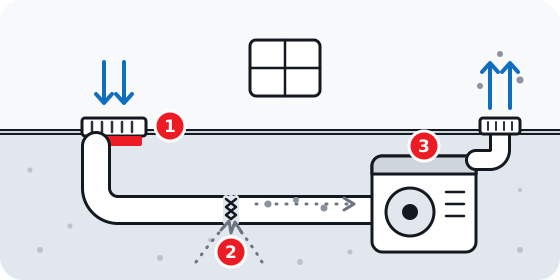
- 1The filter at the return grille
- 2A leak in the return duct pulls crawlspace air in after it
- 3The blower sends that air through the house
- 02
Then, filtration
Then filtration. The one-inch filter at the return grille protects the blower, not you. A properly sized media cabinet has enough surface area to capture much finer particles without restricting airflow. Cramming a high-MERV filter into a one-inch slot achieves the opposite.
A one-inch filter at the grille
- Protects the blower, not you
- A high-MERV one crammed in restricts airflow
A properly sized media cabinet
- Surface area to capture much finer particles
- Without restricting airflow
- 03
Then, humidity
Then humidity, which runs both ways here. Summer damp encourages mold and makes a cool house feel unpleasant; winter dryness irritates airways and cracks woodwork. Both are controllable.
- 04
Then, fresh air
Then fresh air. Modern tight construction traps moisture, odors and carbon dioxide. A recovery ventilator brings in outside air without discarding the energy you paid for.
- 05
Underneath it all: carbon monoxide
And underneath all of it: a carbon monoxide detector on every level if anything in your house burns fuel. That one is about safety, not comfort.
ChecklistWhat makes the difference
- Fix leaking return ductwork first — it bypasses filtration
- Fit filtration sized for surface area, not just MERV rating
- Control summer humidity to discourage mold
- Add winter humidity for airways and woodwork
- UV at the coil to stop biological growth on wet surfaces
- Ventilation for tightly built modern houses
- Carbon monoxide detection with any combustion appliance
- Change the filter far more often than you think
Common follow-ups
Do I need my air ducts cleaned?
Sometimes, though it is not always needed. If ducts are visibly contaminated, or after building work, it helps. For most houses, better filtration and fixing any leaking return ductwork do far more for air quality than cleaning does.
What filter should I use?
The best one your system can handle without losing airflow — and that depends on the filter housing, not the filter. If you want serious filtration, fit a proper media cabinet rather than a denser filter in a one-inch slot.
Would you like help with your own system?
Free estimates on new equipment. We measure before we quote.
(423) 357-1922